The Math of Leaving: Why the Economy Matters Less Than the Market you Choose
Aug 28, 2026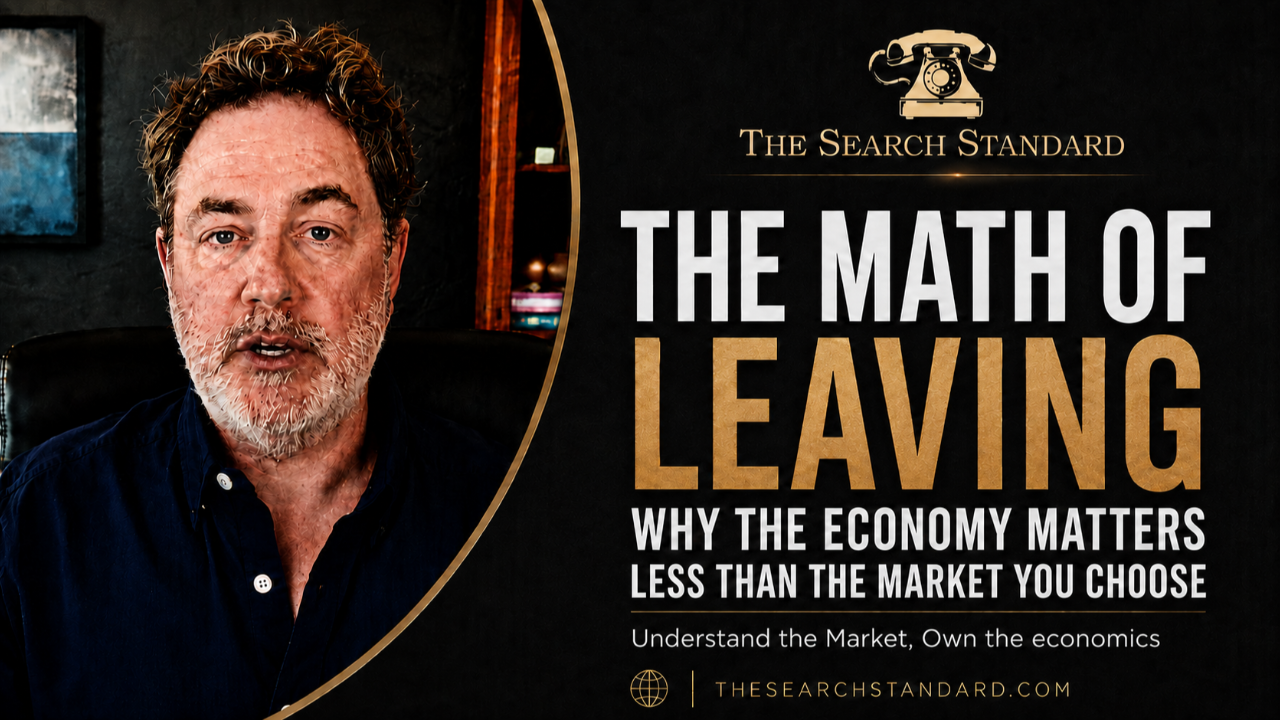
April 2009. I was sitting at my desk in Montana, running a five-desk office.
I'd led the build of our firm's pharmacist recruitment division in Culver City, California from 2001 to 2006. When I moved to Montana in 2006, I kept doing the exact same work remotely for a year and a half.
The two owners in California then approached me with an offer: open and run a physical office here, and they'd give me one-third ownership.
I was excited about the offer. It felt like the right next step, and we built out the office.
By 2009, the Great Recession was about as deep as it got. Firms were struggling and some were folding. But our small five-desk branch kept producing because the pharmacist recruiting market still had a favorable supply-and-demand dynamic.
The Dow didn't change that.
I had trained three excellent producers in that room. I was running the day-to-day operation. And I was doing it for one-third of the profit.
So I approached the two owners in California with an offer: I'd keep running the office, but I wanted 100% of my personal billings.
They said no.
I did the math again.
I decided to bet on myself and resigned to go independent.
Three months later, I closed my first solo deal.
The rest is history.
Macro Conditions vs. Micro-Market Economics
I'm sharing this story now because while we aren't technically in a recession, there is significant uncertainty about where work is headed.
Corporate structures continue to consolidate. AI is changing workflows across industries. Companies are trying to figure out what work should be automated, what work still requires people, and how many people they actually need.
No one knows exactly where that ends. But you don't need to know.
Nobody calls economic tops and bottoms consistently. You don't need to predict GDP, interest rates, the stock market, or what the Fed does next if you deeply understand the economics of your own micro-market.
That was true for me in 2009. Pharmacists were scarce. Hospitals and other healthcare organizations needed them. The problem was expensive enough that employers were willing to pay someone who could solve it.
The macro economy was terrible. The micro-market still worked.
Today, there are similar structural forces hiding beneath the economic noise. Healthcare is one obvious example. The workforce is aging while demand for care continues to increase.
Rates move. GDP fluctuates. Hiring slows. Demographics don't reverse because the Fed shifts policy.
The opportunity is in understanding which problems are cyclical and which ones are structural.
The Economics of Search
Recruiting is a particularly interesting business because it connects an expensive problem to something scarce without requiring a factory, inventory, storefront, or significant amount of capital.
The real assets are knowledge, relationships, market intelligence and the ability to pick up the phone and create movement.
Once you understand a market deeply enough, the economics become pretty straightforward. And you do not need recruiting experience to learn this business.
Search is a learned discipline. The skills required to build and operate a desk can be taught. A person starting from zero can learn the mechanics.
Who is scarce? Who needs them? How expensive is the problem if the company can't find them? And can you become better than almost anyone else at operating inside that narrow market?
That's the calculation. It creates an opportunity for a young professional willing to choose a niche early and out-specialize generalists, a domain expert who already understands where the operational gaps and talent shortages exist, or a firm recruiter who's watching someone else take a percentage of the production they create and beginning to question the same economics I questioned in 2009.
Going independent isn't automatically the right answer. Neither is staying put. The important thing is understanding the math.
When I left in 2009, I wasn't betting that the economy was about to recover. I wasn't predicting the stock market. And I wasn't relying on some abstract belief that everything would work out.
I had spent years inside a market. I understood the demand. I understood the scarcity. I knew I could produce. And I knew what the economics looked like if I owned the desk myself.
That was the bet.
If you're sitting on the sidelines today waiting for the economy, AI, hiring or corporate America to become predictable, you're probably waiting for something that isn't coming.
A better question is: what market do you understand cold, cycle or no cycle?
The bet isn't that everything will work out. The bet is that what you know about your market can matter more than what you don't know about the economy.
That's the thinking behind The Search Standard.
The Search Standard is the operating system for independent search. It teaches the full desk, from choosing a market and developing business to recruiting candidates, executing searches, closing and operating independently.
It comes directly from decades of my own production and the top producers I've trained using the same principles.
This isn't theory dressed up as recruiting advice. And it isn't neuroscience. It is a practical, clearly defined system for doing the work and owning the economics.
You can start with zero recruiting experience and learn it. You can come from inside a firm and use it to build something you own. You can come from an industry you already understand and turn that knowledge into a search business.
The common denominator is the same: learn the market cold, understand the economics, and build the desk around that knowledge.
The Search Standard strikes the match.
Related reading
How to Build a Search Business: Learning Is Easy. Discipline Is Everything
What Is the Best Recruiting Training Program for Independent Recruiters?
Notes From the Desk: What a Week on a Solo Recruiting Desk Actually Looks Like
Ready to Build Your Own Business?
Whether you're breaking into recruiting or building your own independent desk, The Search Standard gives you the operating system to find clients, connect with candidates, build lasting relationships, and create a business you own.
Stay connected with The Search Standard
Get practical insights on recruiting, ownership, and building an independent desk. Join the mailing list to receive new articles and occasional updates from The Search Standard
Your information remains private. Unsubscribe at any time