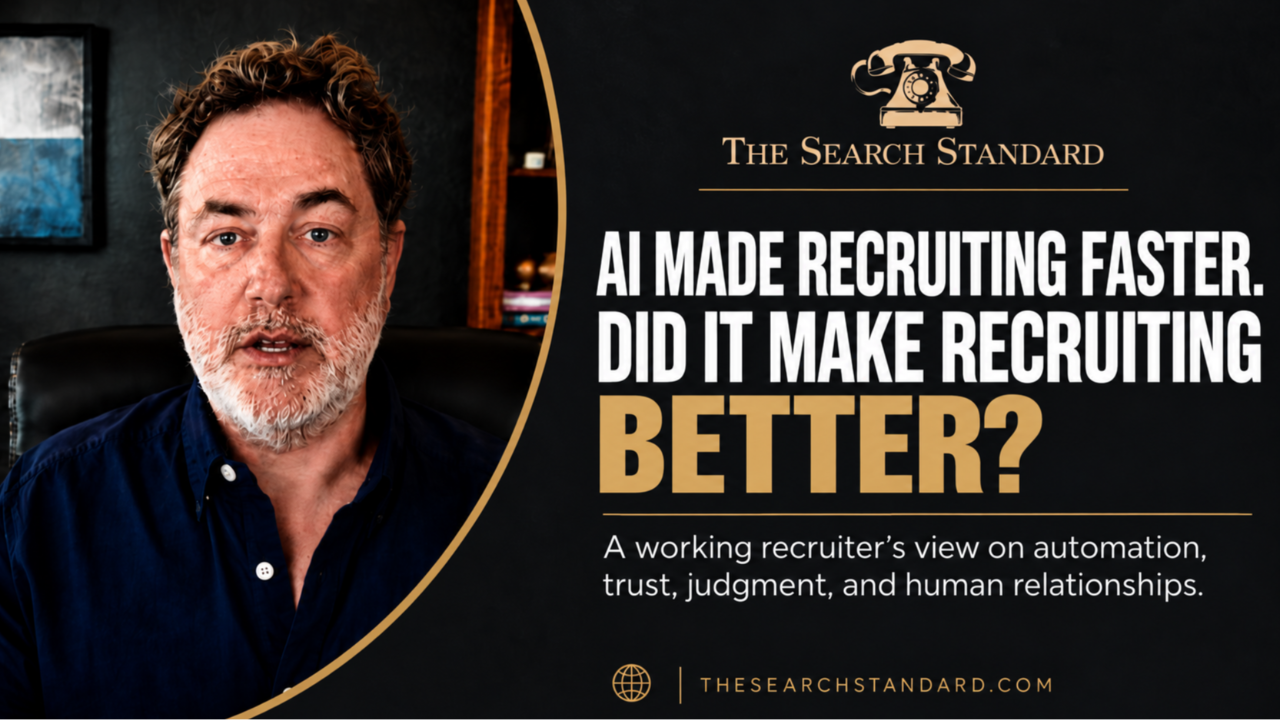
AI Made Recruiting Faster. Did It Make Recruiting More Efficient?
Sep 11, 2026
Technology can generate more outreach, record conversations, and process more candidates.
None of that creates trust on which a good search depends.
The recruiting industry appears to have settled on a goal: make everything faster.
Find more candidates. Send more messages. Conduct more interviews. Record every conversation. Generate the notes automatically. Move more people through the process with less human involvement.
That may be useful in a high-volume hiring operation, but it has almost nothing to do with how I built my desk.
For a long time, I found almost no practical use for AI in my daily recruiting workflow. That has changed.
I have found one application that is genuinely useful to me. It saves me time, gives me information I can act on, and has already become something I use regularly.
What is interesting is that it doesn't replace a conversation, make a judgment for me, or insert itself between me and a candidate or client. It helps me do something I was already doing.
That distinction matters.
The relationship still does the work.
I work with people I have actually spoken with. I receive their permission before approaching a client about them. When I present someone, I give the client context that doesn't exist in the résumé.
Very often, the client is relying in part on my judgment. That judgment matters because it comes from knowing the candidate, not from software deciding that two profiles match.
The Résumé Was Never the Product
A résumé is useful, but it is incomplete. It tells the client where someone has worked, what title they held, and what they want emphasized. It doesn't tell the client how the person communicates, how strong they are relative to others in the market, why they might consider leaving, or whether the opportunity fits their life.
That context comes from speaking with the candidate.
I don't send a résumé and hope it speaks for itself. Most often, I email the résumé with some context: who the candidate is, what I learned from speaking with them, and why I believe they may be a good fit for the position.
My judgment matters, but it isn't the final judgment. The hiring manager knows the operation, the people, and what will work inside that environment better than I do. My job is to give them enough context to make a good decision.
Sometimes they say no and I disagree. If I believe strongly enough in the candidate, I'll make the case for why they should take another look. Sometimes that changes the outcome. Sometimes it doesn't.
That's part of the value of the recruiter. Not deciding for the client but knowing the candidate well enough to add something to the résumé and having enough conviction to speak up when you think the client may be missing someone worth meeting.
The client knows I have spoken with the candidate. The candidate knows I am representing them with permission. Both sides understand my role.
That is what gives the introduction value. A faster résumé match doesn't improve that arrangement. Sending more names may weaken it.
Efficiency for Whom?
The word "efficiency" sounds unquestionably positive until you ask what is being made more efficient.
If a platform allows a recruiter to contact five hundred people instead of fifty, it has increased output. It has not necessarily improved a single interaction.
If AI can summarize an interview, the recruiter may save time writing notes. That doesn't mean the candidate spoke as openly as they would have in a private conversation.
A hiring process can become more efficient for the system while becoming less personal for everyone inside it. That tradeoff deserves more scrutiny than it is receiving.
The objective shouldn't be to create the highest possible volume of automated activity. It should be to create more genuine conversations and use the information from those conversations intelligently.
There is a difference between technology that helps the recruiter understand the market and technology that attempts to replace the recruiter's role inside it.
I'm becoming more interested in the first, and I remain deeply skeptical of the second.
What Happens When Every Call Is Recorded?
Many recruiting platforms are now designed to record, transcribe, summarize, and analyze conversations. I understand the efficiency argument, and I still won't record the candidate or client on the other end of my calls.
People tell recruiters things they haven't shared publicly. They discuss compensation, employers, family considerations, workplace problems, and career decisions that may still be confidential. They speak candidly because they believe they're having a private conversation, and knowing the call is being recorded can change how openly they speak.
Even when someone technically consents, they may reasonably wonder who will hear the recording, where it will be stored, how long it will remain there, and how it might be analyzed later. A person can consent and still become less candid. That makes the conversation easier to process and less useful at the same time.
Inside The Search Standard, students can hear recordings of me making live calls, but only my voice is captured. The person on the other end is never recorded.
Students can hear my approach without turning a candidate or client into instructional material.
Technology gives me the ability to record both sides. Trust gives me a reason not to.
Trust Is Not Friction
Technology companies often treat every additional conversation, judgment call, or personal interaction as friction in a system.
In search, those things aren't friction. They are the work.
The recruiter is trusted with information neither side may be ready to share directly with the other. The candidate may be interested but uncertain. The client may have concerns that don't appear in the job description.
Both rely on the recruiter to understand the context and use good judgment. That requires discretion. Not every piece of information needs to be captured, analyzed, scored, and retained simply because technology permits it.
I'm not arguing that recruiters should avoid useful software. I'm arguing that efficiency should serve the relationship rather than replace it.
And I am more open to that distinction today than I was even a few months ago.
I have now found a use for AI that improves the way I operate. I expect I'll find others.
But the test for me will remain the same: does technology make me better at the work, or does it simply allow me to do more activity?
My desk doesn't need five hundred automated introductions. It needs the right conversations with people who know why I'm calling and trust what I'll do with the information they give me.
That may not produce the highest activity count. I don't care. Activity is not the product. The quality of the relationship is.
Recruiting technology will continue getting faster. Some of it will be genuinely useful.
The real question is whether recruiting gets better, or whether we simply process more people while knowing fewer of them.
Trust is not an inefficiency to be automated away.
It is the reason the recruiter is involved at all.
Ready to Build Your Own Business?
Whether you're breaking into recruiting or building your own independent desk, The Search Standard gives you the operating system to find clients, connect with candidates, build lasting relationships, and create a business you own.
Stay connected withĀ The Search Standard
Get practical insights on recruiting, ownership, and building an independent desk. Join the mailing list to receive new articles and occasional updates from The Search Standard
Your information remains private. Unsubscribe at any time